
Miguel Angel Diaz
Project Manager, Bonavista and Porvenir Schools
Miguel Angel Diaz
Project Manager
A Revolution
Colombia is currently undergoing a major transformation in the development of educational infrastructure, driven by strategic objectives aimed at improving educational quality and expanding access to basic education and vocational training nationwide.
The Ministry of National Education (MEN) has projected the construction of 1,500 educational facilities across the country, including universities, schools, and early childhood education centers. Within this scope and regulatory framework, MEN has established specific criteria for planning, facility design, and learning environments, defining key sustainability strategies for the development of educational infrastructure.
For the upcoming four-year period, the District Education Secretariat (SED) in Bogotá has been tasked with the construction of 35 educational institutions, including schools and kindergartens. Additionally, the Secretariat aims to complete the full planning process for the future construction of 70 additional educational facilities.
Porvenir School: 95% Construction Progress
The studies and designs were delivered by the District Education Secretariat, which contracted RE Arquitectura en Estudio as the design firm.
Through an agreement between the SED and a private entity, the PA–FFIE autonomous trust was assigned responsibility for supervising the construction and oversight contracts. The construction contractor is L&B, and project supervision is carried out by the Construconsultores 2019 Consortium, within which C & M Consultores S.A.S. is responsible for contract administration.
| Porvenir School | |
| Contract | 1380-1334-2020 |
| M2 | 8.823,33 |
| Location | Engativa |
| Approximate contract value | $ 41.361.551.999 |
| Approximate final term | 29.2 months |
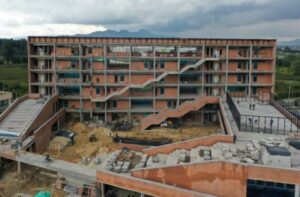
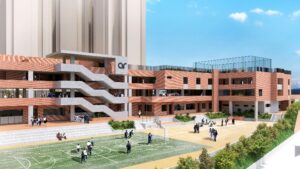
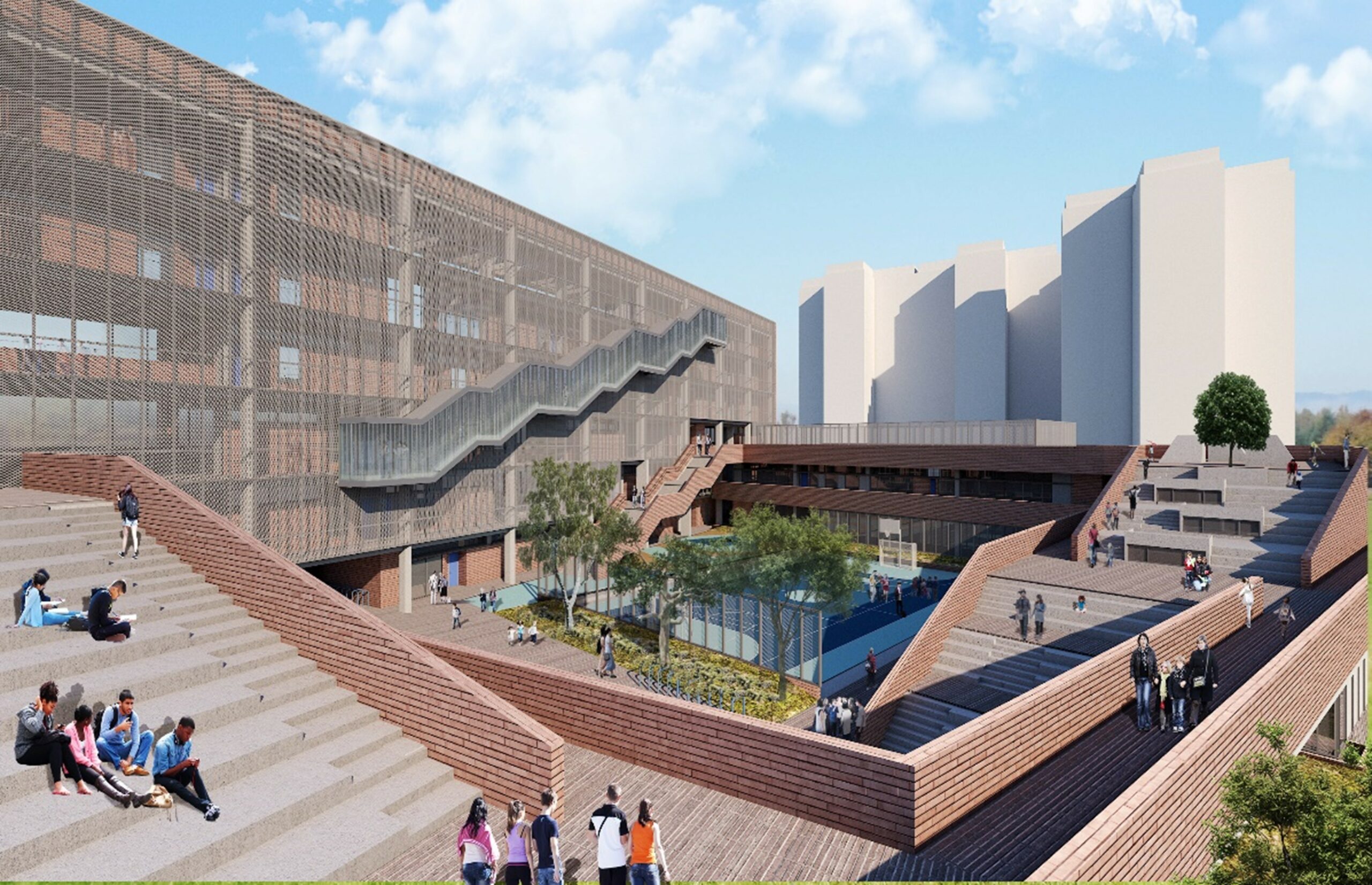
Internal Facade View
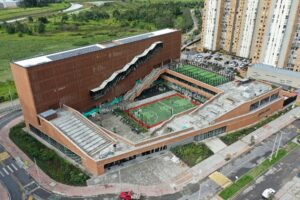
Internal Aerial View of Central Courtyard
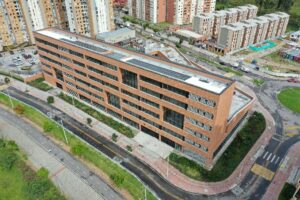
External Facade, Western Side
Project configuration is defined by the following components:
Architectural Design
The project consists of four independent buildings: Block 1 with six floors, Blocks 2 and 3 with three floors each, and Block 4 with two floors.
Vertical circulation is provided through two main elevators and staircases prominently integrated into the internal fade.The school is designed for a capacity of 1,040 students, comprising 8 preschool classrooms, 10 primary education classrooms, 8 lower secondary classrooms, 4 upper secondary classrooms, 2 computer labs, 2 multipurpose classrooms, and 2 CRI classrooms.
As part of its recreational and extracurricular facilities, the project includes an auditorium with seating for 172 students, a synthetic micro-soccer field located on the roof of Block 2, and a multipurpose sports court within the internal campus layout.
Foundations
The building features a deep foundation system consisting of piles with an average depth of 32 meters, connected at the pile heads by pile caps of varying dimensions and integrated through a network of foundation beams.
Structural System
The structural system of the three main buildings combines reinforced concrete frames and shear walls, tied together by floor slab diaphragms with an approximate thickness of 60 cm, ensuring structural integrity and seismic performance.
Walls
The non-structural wall system consists of plastered concrete masonry units and industrialized, dry-installed exposed vertical perforated masonry.
Building Systems
The project incorporates integrated systems for voice and data networks, electrical installations, fire detection, fire protection, mechanical ventilation and extraction for kitchens and the auditorium, a public address system, and a storm detection system.
Sustainability
The project includes 80 solar panels as part of its clean energy utilization strategy.
Bonavista School: 41.46% Construction Progress
As a project based on a design donation from the AR Foundation to the District Education Secretariat, Bonavista School has presented multiple challenges across all project teams. A Hybrid-Agile methodologywas implemented, addressing both the lack of definition in certain design components and the need to resolve critical issues that initially prevented the start of construction activities.
Design coordination carried out in parallel with construction execution and project monitoring has established a value-added collaborative approach among all stakeholders. This methodology has enabled adherence to the construction schedule, maximized interdisciplinary integration, and activated the adaptive capacity required to advance the project without disruptions.
| Bonavista School | |
| Contract | 1380-1335-2020 |
| M2 | 10.562,15 |
| Location | Ciudad Bolivar |
| Approximate contract value | $ 30.018.721.592 |
| Approximate final term | 23 months |
The studies and designs were delivered by the District Education Secretariat following the acceptance of the AR Foundation’s design donation. Through an agreement with a private entity, the SED assigned the PA–FFIE autonomous trust responsibility for supervising the construction and oversight contracts. The construction contractor is Urbaniscom, and project supervision is performed by the Construconsultores 2019 Consortium, within which C & M Consultores S.A.S. is responsible for contract administration.
Project configuration is defined by the following components:
Architectural Design
The project consists of four independent buildings: Block A with four floors, Block B with three floors, Block C with four floors, and Block D with four floors and one basement level.
Vertical circulation is provided through one main elevator and staircases distributed along three internal fade routes.
The school is designed for a capacity of 1,110 students, comprising 6 preschool classrooms, 8 primary education classrooms, 10 lower secondary classrooms, 6 upper secondary classrooms, one computer lab, and one CRI classroom.
As part of its recreational and extracurricular facilities, the project includes an auditorium with an approximate capacity of 250 students, as well as two soccer fields: one located on the roof of Block C and another within the internal campus layout.