
Marcela Barrios
Communications Coordinator
Marcela Barrios
Communications Coordinator
In an unprecedented effort to boost infrastructure development in Colombia, and with the objective of advancing the Bicentennial Concessions Program—also known as the fifth generation of concessions (5G)—the Government has taken a major step forward with the award of concessions for the financing, preparation of final studies and designs, environmental management, land acquisition, social management, construction, rehabilitation, improvement, operation, and maintenance of the Magdalena Trunk Lines 1 and 2. The notices to proceed were signed in December 2022 with the consortia “Estructura Plural del Río Grande” and “Estructura Plural Autovía Magdalena Medio,” both formed by Grupo Ortiz and the Colombian company KMA Construcciones.
The Magdalena Trunk Lines 1 and 2 are currently in the pre-construction phase, with progress levels of 50% and 70%, respectively. Priority interventions are being carried out, including crack and fissure sealing, patching and pothole repairs, settlement corrections, signage, landslide removal, and cleaning of road shoulders, ditches, and medians, among others. To date, these actions have covered 203 km across both concessioned corridors. Beyond their economic impact, however, these projects represent tangible hope for local communities. They are expected to generate more than 600,000 jobs, providing a vital source of income for many Colombian families.
In this way, the concession advances toward configuring the entire corridor as a continuous dual carriageway. During the pre-operational stage, which will last 59 months, activities will include the maintenance and operation of the roads handed over to the concessionaires, as well as the preparation of alignment and design studies for the functional units under their responsibility. In addition, the required environmental permits and licenses will be obtained. Construction is expected to begin on December 1, 2023; however, the largest-scale works are projected to start in 2024, followed by the operation and maintenance stage, estimated to last 20 years.
A look at the structuring process
The year 2017 marked a milestone in the progress of the country’s road infrastructure. The Consorcio Estructurar 2017, led by the renowned firms C & M Consultores, Ikon Investment Banking, and Gómez Cajiao, achieved a major breakthrough by carrying out comprehensive feasibility studies for the continuation of the road concession project Ruta del Sol – Sector II, now known as the Magdalena Trunk Line. Thanks to the collaboration of experts in consulting, design, and construction, these roads promise to deliver a safer, more efficient, and more prosperous future for all users. The Magdalena Trunk Line will become a symbol of development and modernity, facilitating connectivity and economic growth in the region. This progress represents a significant step toward building a high-quality road network capable of meeting mobility needs and promoting sustainable development in the area.
Within the framework of planning the strategic corridors of Sabana de Torres – Curumaní, an ambitious road infrastructure plan was proposed, contemplating the execution of 271 km of dual carriageway. This will allow travel speeds of up to 100 km per hour, ensuring safety, connectivity, and progress for the region. The project extends from the Sogamoso Bridge to Curumaní and involves the construction of 126 km of new roadway and the improvement of 113 km of existing roads. Additionally, it includes the rehabilitation of 27 km of roads in 18 population centers, including La Gómez, El Tropezón, Las Palmas, La Mata, Pelaya, La Floresta, El Burro, Pailitas, Las Vegas, and Curumaní.
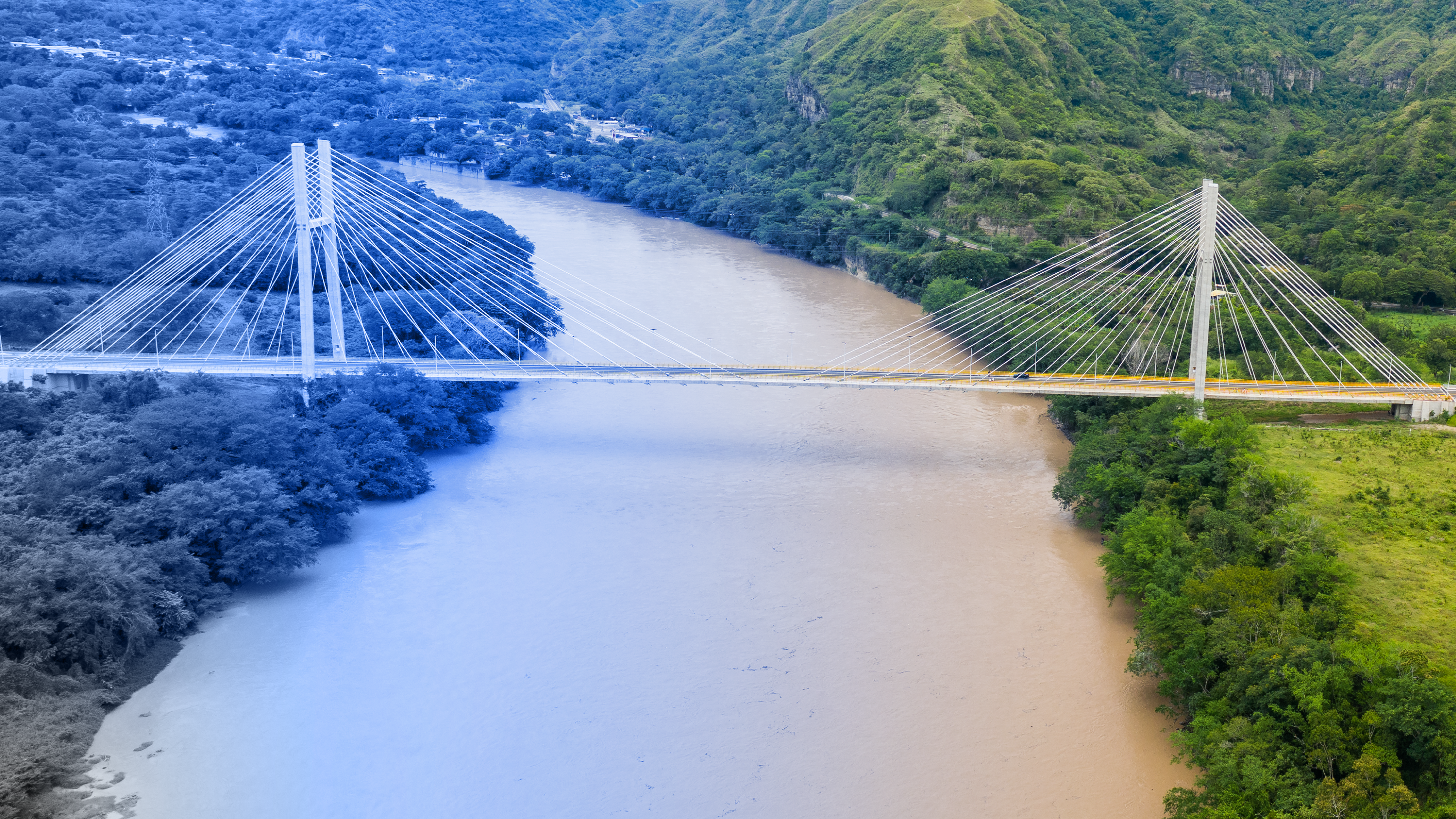
To ensure continuity of the dual carriageway, 1,024 meters of road bridges over the Magdalena River are planned. Significant complementary works are also highlighted, such as the San Alberto South interchange, which will improve connectivity with the dual carriageway for users traveling to and from the municipality of San Alberto. Likewise, the structuring process included viaducts that will facilitate direct access to the population centers of Pailitas, Curumaní, and San Martín. To respond to the expected high traffic volume, the toll lanes at La Gómez will be expanded, and 43 pedestrian bridges will be built to enhance pedestrian safety and mobility.
The road will feature advanced real-time intelligent transportation systems, including S.O.S. systems, variable message signage, closed-circuit television, and traveler speed information systems. These are designed to facilitate traffic information and improve communication in emergency situations. In addition, ambulance services, tow trucks, mechanical assistance, and 24/7 immediate response services will be available.
Likewise, the Consorcio Estructurar 2017, responsible for the structuring and design of the Puerto Salgar – Barrancabermeja road corridor, spanning 260 km, developed a comprehensive strategy to significantly improve this important route. The proposal includes the construction of 148 km of entirely new carriageway, the modernization of 147 km of the existing roadway, and the rehabilitation of 12 km in key populated areas such as Puerto Libre, El Trique, Dos y Medio, San Pedro de la Paz, Palmas de Guayabito, Aguas Negras, and Campo 23.
The La Fortuna interchange is also noteworthy, as it will connect the dual carriageway with roads leading to Yondó, Barrancabermeja, and Bucaramanga, thereby facilitating a direct link between the country’s central region and the Atlantic Coast. To ensure continuity of the dual carriageway, bridges are planned over the Carare River (240 m), La Colorada River (156 m), and Opón River (100 m), maintaining the project’s typical cross-section, along with 25 pedestrian bridges to enhance pedestrian safety and mobility. Toll lanes at Zambito and Aguas Negras will also be expanded to meet traffic demand.
Regarding road safety, an Emergency Communication System will be implemented, allowing users to request assistance quickly and free of charge through calls to the control center. This road corridor will offer users significant time savings in their journeys.
The Magdalena Trunk Lines 1 and 2, together with the Ruta del Sol 3 project, represent significant investments that will not only improve connectivity and trade, but also drive economic and social growth throughout the country. They constitute a bold step toward a prosperous future and a clear demonstration of the Government’s commitment to Colombia’s sustainable and equitable development.